

In the spring of 2023, Crystal Loos began noticing something wasn’t right with her daughter. The once bubbly elementary school student seemed distracted and started pulling away from school, friends, and daily life.
Loos, an Illinois mother of three, said her daughter, Lacy Mae, stopped eating foods she once enjoyed. At first, she thought anxiety or depression might be the cause.
“Before this, she was the happiest, funniest, most outgoing child ever. She never had any issues,” Loos, 30, said.
By July 2024, the situation escalated.
“It was a complete overnight change,” Loos explained. Her daughter, then 9, no longer felt like “herself.”
Although doctors diagnosed Lacy Mae with anxiety and depression, Loos said those explanations didn’t align with what she was witnessing.
“They tried to put her on SSRIs, they tried to get her into a psychiatrist, psychologist, everything,” she said. “But I just felt that there was something deeper going on.”
Loos described one night in July as a turning point.
“That night… it was like she had a psychotic break,” she said. “She was banging on my door. She was begging to go to the hospital. She knew something was wrong, but she didn’t know what… It was just like she didn’t have control over her brain.”
In the days that followed, Loos said her daughter barely slept, became paranoid, and repeatedly begged to be taken to the hospital.
“It was utter terror, like she wasn’t herself,” Loos recalled. “She had dilated pupils. You looked at her, and she just wasn’t the same kid… it was like something took over her.”
They visited multiple hospitals, but Loos said the response remained the same: anxiety and depression.
Her daughter, she said, became desperate to be admitted to a psychiatric unit.
“She’s 10 years old, so that’s crazy, obviously, but she just wanted her health to get fixed,” Loos said. “She begged, begged, begged to be admitted… She was, at this point, suicidal.”
Loos said there were moments when the family had to physically intervene to keep everyone safe.
“We had to sometimes hold her down because she was trying to hurt herself or us,” she said. “Sometimes we would have to lock her and us in a room together so that she wouldn’t. She was more of a danger to herself than us.”
At the time, Loos had recently given birth, and she said her parents stepped in to help.
“Eventually, she did have to move in with my parents because I had a newborn baby, and then I also have a 5-year-old,” she said. “And my 5-year-old was just terrified of her… Rage is what I could describe her. She had so much rage in her.”
Lacy Mae refused to eat, stopped attending school, and missed most of fourth grade. Some suggested the family’s new baby triggered the changes, but Loos said the behavior went far beyond normal adjustment issues.
“I’m like, ‘You guys don’t get it,’” she said. “She was running away from home. She was trying to jump out of moving cars, like just complete psychosis.”
Eventually, Lacy Mae entered a behavioral health unit. While her daughter was there, Loos began searching for other parents with similar experiences. She joined Facebook groups, asked questions, and came across a term she hadn’t known before: PANS/PANDAS.
She researched the condition and returned to the children’s hospital psychiatrist with a request.
“I literally begged,” she said. “I said, ‘She has something wrong with her. I think this is what it is: PANS / PANDAS. Can we do any further workup?’ They refused to do that.”
According to Stanford University School of Medicine, Pediatric Acute-onset Neuropsychiatric Syndrome, or PANS, is a clinical diagnosis in children marked by a dramatic, sometimes overnight onset of neuropsychiatric symptoms. These often include sudden obsessive-compulsive behaviors or eating restrictions, along with depression, irritability, anxiety, sleep disruption, behavioral regression, and difficulty with schoolwork.
Pediatric Autoimmune Neuropsychiatric Disorders Associated with Streptococcal Infections, or PANDAS, is considered a subset of PANS. The PANDAS Physicians Network lists five diagnostic criteria, including sudden onset OCD or severe tics, an episodic course, early age of onset, neurologic abnormalities, and a recent streptococcal infection.
Because there is no single official test for PANS or PANDAS, Loos said it took time and persistence to find a clinician willing to evaluate her daughter from that perspective.
She eventually removed Lacy Mae from the psychiatric unit and sought a specialist. The family contacted Indiana-based Dr. Antoine, and in September 2024, Loos said extensive blood work led to an official diagnosis.
Treatment included antibiotics and IVIG, or intravenous immunoglobulin, which can help regulate immune response.
“She had different infections in her body that were mistakenly attacking her brain,” Loos said. “She had a tick-borne illness. She had mycoplasma… pneumonia… and these are all things that Dr. Antoine checked for. That’s how we figured out what was going on.”
Loos said her daughter received antibiotics to treat the infections and support immune regulation, along with IVIG and supplements.
Over time, Loos said her daughter began to improve, and by December 2024, she started recognizing the child she once knew.
“We started to see her again,” Loos said.
Although setbacks occurred, she said the episodes became less severe.
“I was having just so much anxiety through all this because I was like, I don’t know what to do,” she said. “I can’t even describe how bad it was. It was literally like a living hell.”
Loos said Lacy Mae was also prescribed an antipsychotic to help stabilize her, and now, just over a year after diagnosis, her daughter is “99%” back to herself.
“She does have some setbacks and a little bit of anxiety here and there,” Loos said, “but for the most part… she has been thriving, and life is pretty much back to normal.”
Loos said her daughter has returned to school, sports, and spending time with friends.
“She goes to school. She plays sports. She plays with her friends, which she hasn’t done for a while,” she said. “Now she’s completely back to living life and enjoying life again.”
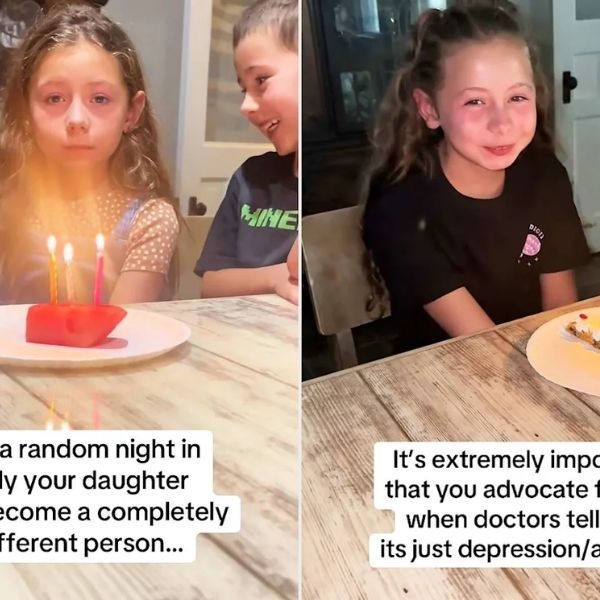
Recently, Loos shared a TikTok video showing her daughter before and after treatment to raise awareness about PANS and PANDAS. The video went viral, reaching more than 45 million views.
Since then, she said parents have contacted her with similar stories of sudden behavioral changes, alarming symptoms, and limited answers. She has helped connect many of them with resources and support.
“I want parents to get answers,” she said. “I want them to know that this is a thing and something to look into if your child has similar symptoms. I wish I would have found it sooner, before our life got really hard with it.”
Loos said isolation was one of the most difficult parts.
“When we were going through this, I was really struggling because I didn’t feel like I could find other parents that were dealing with this,” she said. “It’s very, very lonely… and there’s just not a lot out there.”
Now, she said her focus is on education, believing the condition is often overlooked.
“It’s not widely known,” she said, adding, “Although I think it’s honestly not a rare diagnosis. It’s more common than we think. I think it’s just often misdiagnosed as other things.”










Leave a Reply