

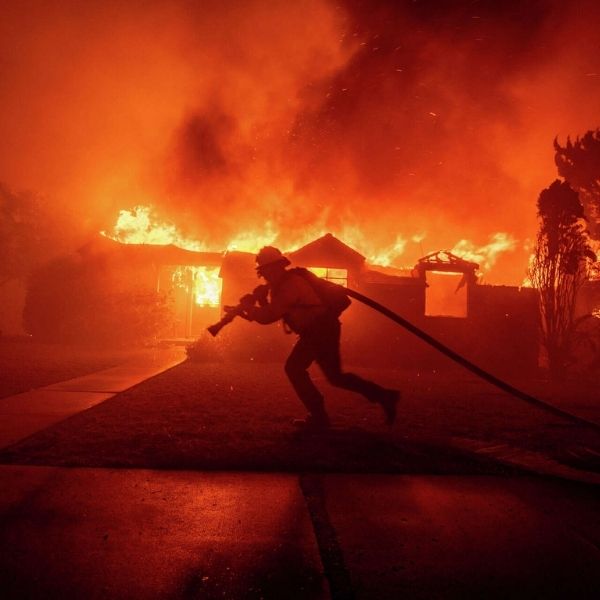
On the morning of Jan. 7, 2025 — 13 days before Donald Trump was sworn in as president — one of the deadliest and most expensive fires in California history erupted in the dry, chaparral-covered hills above the Pacific Palisades.
Driven by powerful Santa Ana winds with gusts reaching 80 miles per hour, the fire tore through the affluent Los Angeles County neighborhood for more than two weeks, leaving widespread destruction in its wake.
More than 7,500 firefighters and emergency personnel responded to battle the blaze. By the time it was finally contained, the Pacific Palisades and Eaton fires — the latter igniting around 6 p.m. the same day in nearby Altadena — had scorched nearly 40,000 acres, about three times the size of Manhattan. More than 150,000 Los Angeles residents were forced to flee, 31 people lost their lives, and over 16,000 homes, offices, schools, and other buildings were destroyed.
As thick black smoke first rose into the sky, then–NBC News national correspondent Jacob Soboroff, who grew up in the Pacific Palisades, was already on the ground, reporting what he saw as the disaster unfolded.
His latest book, “Firestorm: The Great Los Angeles Fires and America’s New Age of Disaster,” delivers a gripping, firsthand account of what became one of the most devastating natural disasters in California’s history.
“Angelenos were running, suitcases and pets and children and elderly relatives in tow, dispersing in all directions, smoke and embers chasing them as they attempted to escape,” Soboroff writes in one harrowing passage, describing the winding road out of the Palisades hills clogged with crashed and abandoned vehicles.
In another unsettling moment, he reflects on the confusion surrounding the fire’s size and speed. “What I couldn’t put into words then was the sheer scale of what was unfolding around me. It felt as though a tropical storm or hurricane was blowing through our coastal California community, with scalding embers playing the part of pelting rain. … Nobody knew what would happen next. If what they were smelling was their lives on fire.”
Amid the chaos, Soboroff maintained his determined yet measured reporting. He spoke with firefighters such as Eric Mendoza of Engine Company No. 69, interviewed local shop owners he had known since childhood, and followed residents wrestling with the decision to stay and defend their homes or evacuate. He also sought insight from local and national leaders, including Gov. Gavin Newsom.
Some of the book’s most powerful scenes place readers directly in the turmoil, describing fire engines running low on fuel, hydrants failing to deliver enough water, and the sudden realization of losing everything in an instant.
The book also delves into the political climate surrounding the disaster. Soboroff examines Donald Trump’s tendency to spread misinformation about the fires on Truth Social, his attacks on “Gavin Newscum,” and the efforts of Trump’s second administration to “refute, dismantle, or outright eliminate valuable resources within the federal government’s arsenal to communicate about, respond to, mitigate, or prevent disasters.”
What the book lacks, however, is a deeper exploration of the underlying causes of the fires — including the “global climate emergency, infrastructure disintegration, changes in how we live, and politics of blame and disinformation” — and how similar catastrophes might be prevented.
Soboroff addresses that limitation directly.
“I’m not a civil engineer, or a climate scientist, or an urban planner, or someone with the ability to reverse the polarization in our politics,” he writes. “But I am a journalist guided by a simple principle: Report the facts on the ground as I always have done. To tell you, as I always endeavor to do, what I saw, who I met, and what I learned during and after the Great Los Angeles Fires about America’s New Age of Disaster.”
For readers seeking deeper context on wildfire history and prevention, several other recent works offer valuable insight. These include Jordan Thomas’s “When It All Burns: Fighting Fire in a Transformed World,” Clare Frank’s “Burnt: A Memoir of Fighting Fire,” River Selby’s “Hotshot: A Life on Fire,” and Kelly Ramsey’s “Wildfire Days: A Woman, a Hotshot Crew, and the Burning American West,” all written by those with firsthand experience on the fire lines.



Leave a Reply