

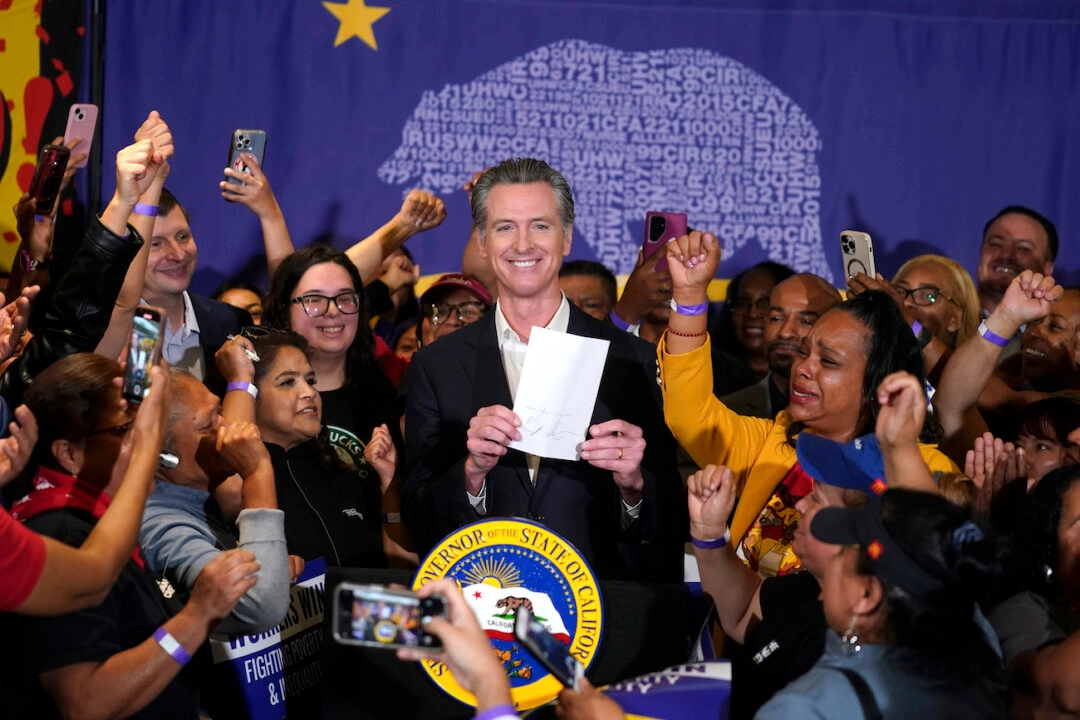
California fast-food workers will receive a pay increase to $20 per hour under legislation signed into law by Gov. Gavin Newsom on Thursday.
The wage hike will take effect on April 1, 2024. It applies to employees working at restaurants with at least 60 locations nationwide. However, restaurants that bake and sell their own bread are exempt from the new minimum wage requirement.
Assemblymember Chris R. Holden (D-Pasadena) introduced the bill, AB 1228. The legislation authorizes the Fast Food Council to set minimum wage levels for fast-food restaurants and recommend guidelines on issues such as health and safety standards and training.
This increase makes California the state with the highest guaranteed base pay in the fast-food industry.
In 2022, the average hourly wage for fast-food workers in California was $16.21. Currently, workers earn an average of $16.60 per hour, or just over $34,000 annually, according to the U.S. Bureau of Labor Statistics.
That amount falls below the California Poverty Measure for a family of four, a metric calculated by the Public Policy Institute of California and the Stanford Center on Poverty and Equality that factors in housing costs and publicly funded benefits.
California’s minimum wage for all other non–fast-food workers is already among the highest in the country at $15.50 per hour.
“California is home to more than 500,000 fast-food workers who—for decades—have been fighting for higher wages and better working conditions,” Mr. Newsom, a Democrat, said in a statement Thursday.
“Today, we take one step closer to fairer wages, safer and healthier working conditions, and better training by giving hardworking fast-food workers a stronger voice and a seat at the table.”
Speaking at an event in Los Angeles, Mr. Newsom pushed back against the idea that fast-food jobs are primarily for teenagers entering the workforce.
“That’s a romanticized version of a world that doesn’t exist,” he said. “We have the opportunity to reward that contribution, reward that sacrifice, and stabilize an industry.”
The law also establishes a council to review and consider annual wage increases through 2029, based on either a 3.5 percent raise or the average change in the U.S. Consumer Price Index for urban and clerical workers, whichever is lower.
Mr. Newsom’s signature underscores the influence of labor unions in California, which have long pushed for higher wages for fast-food workers.
The agreement also resolves a dispute between labor unions and fast-food companies over industry regulation. Under the deal, labor unions agreed not to hold fast-food brands responsible for violations by independent franchise operators in California. In exchange, fast-food businesses agreed not to pursue a referendum on worker wages in 2024.
“That was a tectonic plate that had to be moved,” Mr. Newsom said, referring to the more than 100 hours of negotiations required to finalize the agreement during the final weeks of the legislative session.
Mary Kay Henry, president of the Service Employees International Union International, said the new law reflects years of organizing, including roughly 450 strikes statewide over the past two years.
California lawmakers are now turning their attention to other industries and have recently passed legislation to gradually raise the minimum wage for healthcare workers to $25 per hour.
Meanwhile, the federal minimum wage for other sectors has remained unchanged at $7.25 an hour since 2009, equal to $15,080 annually for someone working 40 hours per week.








Leave a Reply